
The Prime Minister’s Masterpiece: Churchill’s “Their Finest Hour” Speech
If you look at the final page of the text Churchill used to make this great speech, you can’t help but notice that he arranged the text in what looks like blank verse which is grouped in stanzas. Since this is the version he used to deliver the speech, it no doubt helped him create the rhythm he wanted for the speech. Earlier drafts are all typed in paragraphs and look like any other page of printed text. He wasn’t going to use them to deliver the speech.
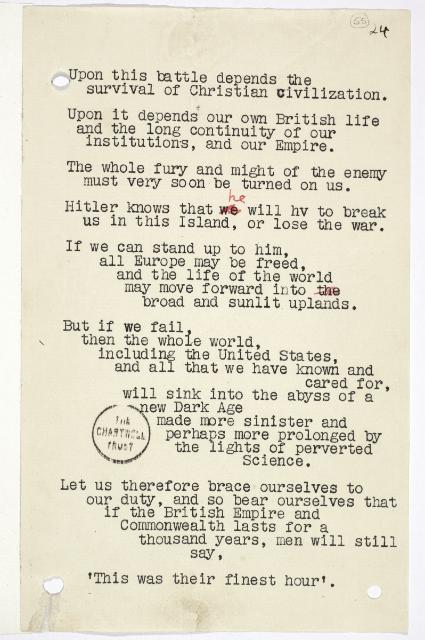
You also see that he makes changes even in the final draft suggesting that he’s continually revising the text right up until the time he delivered it—first in the House of Commons and then over the BBC to the nation. You also notice that he used abbreviations for familiar words—e.g., hv for have, bn for been, cd for could, etc. These probably helped save space and gave the page a cleaner, easier-to-read look with the extra spaces between each line. That white space creates what I call “air” and makes the speech not only easier to deliver in a more conversational style, but also leaves room for the speaker to make last-minute notes or changes in the text. The air also leaves room for pauses in which the speaker can catch his breath and the audience can catch up.
Finally, you see short, double horizontal lines have been penciled in between paragraphs denoting places where he wants to pause.
Basically, he has given himself the stage directions he needed to make what many consider to be the most important speech of his life.
What was at stake? As he said in his first speech as Prime Minister, nothing short of survival. France has just fallen to Hitler’s powerful army. What’s left of the British and allied armies has just been rescued from the continent. All that stands between Great Britain and the enemy is the English Channel. He must prevent panic and rally a nation to resist against terrific odds.
How does he do it? First, by being candid about the situation. (Compare with FDR’s First Inaugural where he has to acknowledge the dire economic straits the country is in order to maintain his credibility.) Churchill explains what has happened and how serious the situation is. But unlike Roosevelt, he is careful not to point fingers and look for scapegoats—in the military or in government. There’s only one villain in this speech and that is Hitler.
This is the time to pull together, not a time for blame. He says it’s up to future historians, not the present generation to do the judging. The beautiful image of putting all these facts “on the shelf from which historians will select their documents to tell their stories” sounds like a poet wrote it. Like Lincoln or any other great speechwriter, he loves the language. And it shows in the images he creates and the sound of the words he uses. Later, emphasizing the difference between the present and the future, he says, “If we open a quarrel between the past and the present, we shall find that we have lost the future.” And, like Lincoln’s “Gettysburg Address”, the future is what this speech is all about. The future of the nation can’t be secured without the sacrifice of those who serve and those who support them.
He’s candid, but he’s also inspiring. Candor is part of being inspiring. Compare Churchill’s speech with Dr. King’s “I Have a Dream” speech. King first had to acknowledge the nightmare of the past treatment of his people that continued into the present before he could hope to lead them with his vision of equality. You don’t need to be inspired if you’re not down or facing tough odds. To transcend from the bleak present to the bright future requires sacrifice and action and leaders who can inspire with their words as well as their example.
In one sense this speech is just as much a persuasive argument as it is an inspirational speech. He knows and acknowledges the seriousness of the situation.
So Churchill spends a lot of time reviewing the present situation and how the nation got to where it is. Like Nixon in his famous “Checkers” speech, Churchill lays out the many questions that the people have and he answers them frankly with specifics to back up what he’s saying. In one sense this speech is just as much a persuasive argument as it is an inspirational speech. He knows and acknowledges the seriousness of the situation. He also knows the counterarguments and concerns that people have at this point and addresses them point by point. He can’t be successful if he’s not considered credible and he won’t be credible if he’s not honest. The United Kingdom had to pull together—elected officials and those who elected them as well as members of the commonwealth—to survive the massive force aligned against the small island nation. And he pulls them, and even his country’s powerful former colony, the United States, together by appealing to their common language and cultural heritage. Their shared history.
You need a rhythm to get people marching. Churchill created rhythm through balanced sentences, antithesis, alliteration, anaphora, and soaring rhetoric.
“They have suffered heavily,
But they have fought well.
…
“If necessary for years,
If necessary alone”
…
“This decision was painful,
But it was also right…”
“That battle was lost
By the unfortunate strategic opening,
By the extraordinary unforeseen power
Of the armoured columns,
And by the very great German preponderance
In numbers.”
…
“Therefore in casting up this dread
Balance sheet,
And contemplating our dangers
With a disillusioned eye,
I see great reason for intense
Exertion and vigilance,
But none whatsoever for panic or
Despair.”
…
“What General Weygand calls ‘the battle
of France’ is over.
The battle of Britain is about to begin”
To have credibility Churchill had to be candid.
But to be inspirational he also had to be positive. The troops got out of France with most of their equipment. They are a well-trained and tested army. They’re in better shape to defend their island now than they would have been earlier. Britain’s pilots have out-flown their German counterparts. Britain has a short supply line versus the long one of the enemy. The morale of the people and of the army is good. All are united in commitment.
Churchill’s rhetoric soars at the end as King’s did in his Dream speech. He creates images and allusions to past greatness, putting this present crisis into a context of historic deeds. His ending echoes Shakespeare’s King Henry V rousing his badly-outnumbered troops on the fields of Agincourt (Act IV, sc.iii) “We few, we happy few, we band of brothers…”
A call to arms not just to save a country, but to save a civilization. A way of life. Who doesn’t want to be part of that heroic effort?
 Buck Benedict